

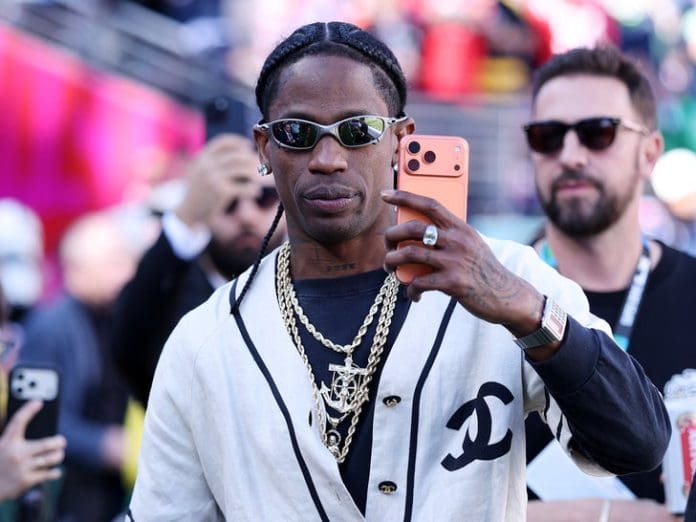
Travis Scott, Killer Mike, T.I., Young Thug and Fat Joe have filed legal briefs with the United States Supreme Court (SCOTUS) urging the justices to halt the scheduled execution of a Texas death row inmate whose handwritten rap lyrics were introduced as evidence during his sentencing, in a case that has ignited a national debate about the criminalisation of artistic expression.
The inmate at the centre of the case is James Garfield Broadnax, who was 19 years old when prosecutors say he killed two men during a robbery near Garland, Texas, in 2008. In 2009, a nearly all-white jury convicted him of double murder after prosecutors had eliminated all prospective jurors who were Black. Broadnax is scheduled to be executed on April 30, 2026.
The lyrics were not introduced during the guilt phase of the trial. They were held back specifically for the sentencing phase, a distinction that legal advocates say matters enormously. During deliberations, the jury twice requested to review 40 pages of Broadnax’s handwritten rap lyrics before deciding he should receive the death penalty. Prosecutors told the jury the lyrics proved he was a continuing threat to society who would probably commit more violent crimes in the future.
Broadnax’s legal team filed a petition asking SCOTUS to pause the execution and accept the case for review. On Monday, March 9, Travis Scott’s legal team, led by attorney Alex Spiro, who also represents Jay-Z, filed a separate amicus curiae brief in support of Broadnax. A second amicus brief backed by Killer Mike, T.I., Young Thug, Fat Joe, N.O.R.E., music scholars and arts organisations was filed the same day.
Scott’s brief argues that the prosecution treated the lyrics not as creative work but as evidence of future violence, contending that the argument implied participation in “gangster rap” signalled a likelihood of criminal behaviour. The filing further argues that rap music, which is primarily created by and historically associated with minority artists, is protected by the First Amendment of the United States Constitution, and that SCOTUS should clarify the constitutional limits of using protected artistic expression as evidence of criminal character.
Dallas appellate attorney Chad Baruch, who represents the coalition of artists and scholars, framed the stakes in broader terms, arguing that the case gives the Supreme Court an opportunity to address the systemic use of rap lyrics against Black defendants in criminal proceedings. Texas attorneys, in their own filings, countered that Broadnax’s lawyers raised the lyric objections too late and that the lyrics represented only a small portion of the prosecution’s sentencing arguments.
Researchers at the University of Richmond have documented nearly 700 cases where rap lyrics were introduced as evidence in criminal proceedings, with those cases overwhelmingly involving Black and Latino defendants.
The Supreme Court has not yet ruled on whether it will hear the case or pause the April 30 execution date.