

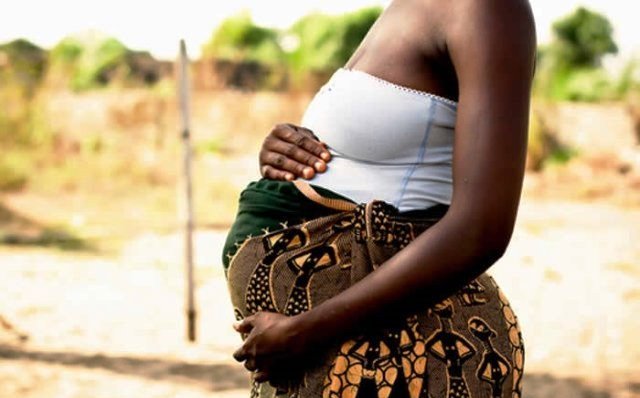
One in seven girls aged 15–19 in Ghana has been pregnant. For 22-year-old Teresa, the statistics are not numbers; they are her life. A story of survival, sacrifice, and a mother’s unyielding love.
On most mornings, Teresa wakes before sunrise in her rented room in Accra. She checks her phone not for messages, but for photos. There, between shifts at the pub where she works late into the night, she finds what keeps her going: a small girl with her mother’s eyes, laughing at a camera hundreds of kilometres away in a village Teresa rarely gets to visit.
“That baby might be your glory,” Teresa says softly. “She might help you one day.” She is 22 years old. She became a mother at 19.
Teresa’s story of a pregnancy discovered just weeks after finishing secondary school, of a family torn apart and slowly stitched back together, of a young woman navigating poverty and loneliness while raising a child across distance, is singular in its details and yet achingly familiar across Ghana.
A CRISIS HIDDEN IN PLAIN SIGHT
According to the 2022 Ghana Demographic and Health Survey, 15% of girls aged 15 to 19 have ever been pregnant, with 11% having already given birth. Behind those percentages are hundreds of thousands of teenagers who faced what Teresa faced: confusion, fear, and the shattering of carefully laid plans.
In urban centres like Accra, teenage mothers often face strained family relationships, financial hardship, educational disruption, and a steep, unforgiving transition to adulthood, a transition most were never prepared to make. Qualitative research on teenage motherhood in Ghana consistently surfaces the same themes: isolation, stigma, and a profound sense of being abandoned just when support is most needed.
Teresa discovered she was pregnant about three months along just after completing Senior High School (SHS) in 2021. She was still living with her mother. Terrified, she said nothing.
“I was afraid of how she would react,” she recalls. “So I hid it.”
THE MEN WHO STEPPED UP – AND THE ONE WHO DIDN’T
When Teresa eventually left to stay with her father in Accra, she found an unexpected ally. Rather than reacting with shame or anger, he contacted the baby’s father directly, confirmed the young man’s responsibility, and arranged antenatal care all without adding to his daughter’s emotional burden.
“My father shielded me,” she says. “He did not let the stress get to me.”
Her mother’s reaction was entirely different. When she finally found out, she wept and then went silent. For weeks, she stopped speaking to her daughter altogether. It is a response that researchers say is common, as families grapple with expectations of respectability and the very real economic pressures a new child brings.
Teresa’s maternal grandfather took matters into his own hands. At around five to six months pregnant, he urged her to move to his village, convinced that the baby’s father, also a fresh SHS graduate with no income, would not provide adequately. In the village, the old man took over: covering antenatal costs, making preparations for the birth, supplemented by the free and low-cost services available at public health facilities.
The baby, a girl, arrived on the morning of July 5, 2022. Teresa was exhausted from labour when her mother walked through the hospital door. What happened next surprised her.
“She started speaking to me again,” Teresa says, her voice still carrying the weight of that moment. “That was when I knew she had forgiven me.”
The baby’s father, meanwhile, faded from their lives. Citing unemployment and plans to learn driving as a trade, he stopped providing financial support. He remains largely absent.
A LIFE REBUILT ON SACRIFICE
Teresa had dreamed of becoming a beautician or hairdresser. Those ambitions were set aside. Instead, she took jobs as a waitress in restaurants, then in pubs, working hours that most would find punishing in a city that offers young women with no qualifications few better alternatives.
To make it work financially, she made one of the hardest decisions a mother can make: she sent her daughter to live with the child’s paternal grandmother in the village. It was a pragmatic choice; it allowed Teresa to work and save, but it came at an emotional cost she does not try to minimise.
For a time, the arrangement held. She paid school fees and sent money for food and essentials. Then her daughter became ill, suffering convulsions that sent Teresa rushing back to the village, praying the episodes would not return.
Today, her support network is thin. Her father, from a wealthy background and currently abroad in London, provides little beyond occasional contact. Her mother, from a more modest background, does what she can, but it is not much. The extended family on her father’s side distanced itself years ago after a painful episode in which they blamed Teresa for the death of her grandmother, a wound that has never fully healed.
The paternal grandmother remains the steadiest presence in her daughter’s daily life.
“I have to give her a future since nobody is going to help. She has me, and I have her.”
THE BROADER PICTURE
Teresa’s situation reflects patterns well documented by public health researchers. Teenage mothers in Ghana are likely to drop out of formal education, face barriers to skilled employment, and raise children in poverty conditions that can perpetuate across generations if not interrupted by sustained structural support.
Access to antenatal care, which Teresa benefited from, has improved in recent years. But post-natal support, economic empowerment programmes for young mothers, and the social infrastructure needed to keep them in education or training remain inadequate for the scale of the need.
What is often absent from policy discussions, advocates say, is the voice and the agency of the young women themselves.
‘DON’T ABORT. EVERYTHING HAPPENS FOR A REASON.’
Teresa has thought about what she would say to another young woman who finds herself where she was in 2021, pregnant, frightened, and unsure of the future.
“Don’t abort,” she says without hesitation. “Everything happens for a reason.”
On difficult days, there she opens her phone and looks at her daughter’s face. The child’s smile, her voice on a call, the photos sent by the grandmother in the village: they are what Teresa calls her only hope. Her reason to keep going.
Her plan is modest but fierce in its determination: save enough to learn a trade, pay school fees a full year in advance, visit next month with food and clothes and the kind of presence a mother owes a child.
“I have to give her a future,” Teresa says, “since nobody is going to help. She has me, and I have her.”
Teresa’s surname has been withheld to protect her privacy and that of her daughter. Statistics are drawn from the 2022 Ghana Demographic and Health Survey published by the Ghana Statistical Service.