
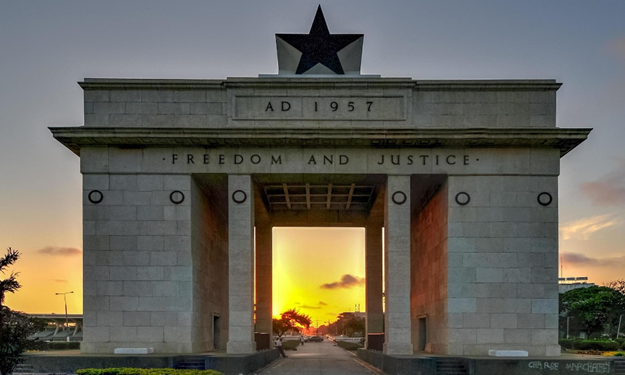
On 6 March 1957, the British colony known as the Gold Coast gained independence and adopted the name Ghana. The choice linked the new state to the memory of a powerful medieval kingdom that had once flourished in the western Sudan of Africa.
The adoption of the name resulted from decades of historical reflection in the Gold Coast. Scholars, teachers and political thinkers questioned the colonial label attached to the country since the era of European trade. Seeking a name with deeper meaning, many turned to the reputation of the ancient Ghana Empire.
To understand how the Gold Coast eventually became Ghana, it is necessary to look first at the medieval kingdom whose name later acquired such symbolic importance in West African historical writing.
The medieval kingdom and its rediscovery
The Ghana Empire emerged in the western Sudan, in a region that today lies largely within southern Mauritania and western Mali. Arabic historians writing between the ninth and eleventh centuries described it as one of the most influential states in West Africa.
The Andalusian geographer al-Bakri, writing in the eleventh century, portrayed Ghana as a prosperous commercial centre linking the gold-producing regions of West Africa with markets across the Sahara and the Mediterranean world.
In these early accounts, the word ghana referred not to the territory itself but to the title of the ruler, often translated as “war chief.” Over time, the title became associated with the kingdom as a whole.
Most historians place the rise of the Ghana Empire between the sixth and eighth centuries, with its political and commercial peak between the ninth and eleventh centuries, before its gradual decline as the Mali Empire expanded in the thirteenth century.
Archaeological research and linguistic scholarship associate the empire with the Soninke-speaking peoples of the western Sahel, and historians often identify Koumbi Saleh, in present-day Mauritania, as one of its principal political centres.
Although the empire eventually disappeared, its reputation survived in scattered Arabic chronicles and geographical writings. When European scholars in the nineteenth century began examining these sources more systematically, the early history of the western Sudan gradually re-entered modern scholarship.
Among the earliest works in this direction was W. D. Cooley’s The Negroland of the Arabs Examined and Explained (1841). Later studies reinforced the image of Ghana as one of the important early states of West Africa. A. B. Ellis, in The Tshi-Speaking Peoples of the Gold Coast of West Africa (1887), recorded migration traditions suggesting that some Akan-speaking groups once lived further inland before gradually moving southwards toward the forest and eventually the coast.
At the beginning of the twentieth century, the ancient kingdom received wider attention through Flora Shaw Lugard’s A Tropical Dependency: An Outline of the Ancient History of the Western Sudan (1905). Drawing extensively on Arabic historical accounts, Lugard described Ghana as a major political power of medieval West Africa and emphasised its role in trans-Saharan commerce.
These studies did not suggest that the Gold Coast was geographically identical to the ancient empire. They did, however, restore scholarly interest in Ghana as one of the significant political formations of Africa’s past.
Early Gold Coast interpretations
While European scholars were reconstructing the history of the ancient kingdom, writers within the Gold Coast were also beginning to engage with these historical questions.
Among the earliest of these writers was Rev. J. B. Anaman, whose book The Gold Coast Guide (1895; revised edition 1902) discussed the ancient Ghana kingdom and suggested that movements of peoples from that region might have influenced societies elsewhere in West Africa.
Such arguments were tentative. Modern historical, linguistic and archaeological research has not established a direct migration link between the medieval Ghana Empire and the Akan-speaking peoples of the Gold Coast. Historians, therefore, tend to treat these early interpretations as part of the intellectual climate of the late nineteenth century rather than as established historical conclusions.
Even so, works like Anaman’s helped introduce what later scholars described as the “Ghana hypothesis.” The debate encouraged writers within the colony to situate the history of the Gold Coast within a wider West African past.
Education, historical consciousness and nationalist debate
During the 1920s, discussions about African history gained additional momentum through developments in education.
At Achimota College, for instance, students were introduced to the histories of the great West African states of Ghana, Mali and Songhai as part of a broader effort to include African history within formal education. Educators associated with the institution, including Dr James Kwegyir Aggrey, encouraged students to see Africa’s past not as a blank slate but as a field of historical achievement.
This educational climate did not directly determine the later naming of the country. It nevertheless formed part of a wider intellectual environment in which educated Africans increasingly engaged with the historical depth of the continent.
At roughly the same time, Rev. W. T. Balmer, in A History of the Akan Peoples (1926), suggested that some Akan traditions might preserve distant memories of earlier movements from regions associated with the Ghana Empire. Modern historians generally approach these claims cautiously, noting that available evidence does not confirm a direct historical connection. Even so, the argument contributed to a growing interest in Ghana as a symbol of early African statehood.
The nationalist thinker J. B. Danquah entered this discussion during the late 1920s. In The Akim Abuakwa Handbook (1928), he noted that Akan traditions sometimes referred to the ancient Ghana kingdom.
Danquah also reflected on what the colony should be called if it eventually became independent. In his view, the name Gold Coast, derived from the region’s mineral wealth, reflected the priorities of European commerce rather than the historical identity of its people.
He initially suggested Akanland, but critics argued that such a name would privilege one ethnic group within a diverse colony. Danquah therefore explored other possibilities, including Akan-Ga, before later referring to the idea of “New Ghana,” invoking the prestige of the ancient Sahelian kingdom.
As later noted by anthropologist, Jack Goody, in his 1967 article, “The Myth of a State,” ideas linking the Gold Coast to the ancient Ghana kingdom gradually moved beyond scholarly discussion and entered the wider nationalist imagination within the colony, particularly from the 1930s onwards. The term itself soon appeared in everyday political culture. Slogans such as “Ghana Boy” were painted even on the cabins of mummy trucks (commercial lorries) that travelled the roads of the Gold Coast. These developments suggested that the name Ghana had already begun to acquire political resonance within the colony.
Nkrumah and the final adoption of the name
By the late 1940s these ideas had entered the arena of organised nationalist politics. Kwame Nkrumah played a decisive role in transforming the name Ghana from a subject of historical reflection into the official name of the emerging state.
For Nkrumah, the choice carried ideological meaning. Influenced by Pan-African thought, he sought to situate the emerging nation within a longer history of African civilisation and political achievement. The name Ghana, already associated in historical scholarship with one of the earliest great states of West Africa, offered precisely such symbolism.
One of the earliest institutional uses of the name occurred in 1948, when Nkrumah founded Ghana National College in Cape Coast, nearly a decade before independence.
By the early 1950s the name had begun to appear even in the titles of political organisations, most notably the Ghana Congress Party, which was formed in 1952.
Nkrumah’s commitment to the name continued to appear in his political rhetoric as the struggle for self-government intensified during the early 1950s. When moving what later became known as the “Motion of Destiny” in the Gold Coast Legislative Assembly on 10 July 1953, he declared:
“Throughout a century of alien rule our people have, with ever increasing tendency, looked forward to that bright and glorious day when they shall regain their ancient heritage and once more take their place rightly as free men in the world.”
By the time the Ghana Independence Bill reached the British Parliament in December 1956, the question of naming the new country had effectively been settled within the colony. When independence arrived on 6 March 1957, the British colony known as the Gold Coast formally became the state of Ghana.
History and national imagination
The relationship between the medieval Ghana Empire and the modern Republic of Ghana has long attracted discussion among historians. By the mid-twentieth century, scholars increasingly agreed that the empire lay far to the northwest of the present-day state. This understanding was reinforced by the work of scholars such as Raymond Mauny, Nehemia Levtzion and later Basil Davidson, whose studies of the western Sudan helped clarify the empire’s historical geography. The connection between the two, therefore, belongs primarily to the realm of historical imagination rather than to geography or ethnicity as earlier writers sometimes suggested.
Symbolic historical references nevertheless play an important role in the formation of national identities. By choosing the name Ghana, the leaders of the new state drew upon the scholarship, debates, and intellectual currents of the Gold Coast to place the modern country within a deeper and distinguished African past.








… [Trackback]
[…] Read More Information here on that Topic: africanshowbizz.com/from-gold-coast-to-ghana-history-memory-and-the-naming-of-a-nation/ […]
… [Trackback]
[…] Read More Info here on that Topic: africanshowbizz.com/from-gold-coast-to-ghana-history-memory-and-the-naming-of-a-nation/ […]
… [Trackback]
[…] Read More Information here on that Topic: africanshowbizz.com/from-gold-coast-to-ghana-history-memory-and-the-naming-of-a-nation/ […]
… [Trackback]
[…] There you will find 19316 additional Information to that Topic: africanshowbizz.com/from-gold-coast-to-ghana-history-memory-and-the-naming-of-a-nation/ […]
… [Trackback]
[…] Find More here to that Topic: africanshowbizz.com/from-gold-coast-to-ghana-history-memory-and-the-naming-of-a-nation/ […]
… [Trackback]
[…] Here you can find 80088 more Information on that Topic: africanshowbizz.com/from-gold-coast-to-ghana-history-memory-and-the-naming-of-a-nation/ […]
… [Trackback]
[…] Here you can find 52354 additional Info on that Topic: africanshowbizz.com/from-gold-coast-to-ghana-history-memory-and-the-naming-of-a-nation/ […]
… [Trackback]
[…] Here you can find 55499 additional Information to that Topic: africanshowbizz.com/from-gold-coast-to-ghana-history-memory-and-the-naming-of-a-nation/ […]
Comments are closed.